Finance
Nasdaq Enters Correction as AI Fears Wipe $3 Trillion in a Global Sell-Off
The Nasdaq plunged 5.52% into correction territory on Thursday as fears of tighter AI regulation and doubts over data-centre spending erased the post-midterm rally — and the rout spread across Asia overnight.
By PagalHo News Desk 2h ago · 4 min read
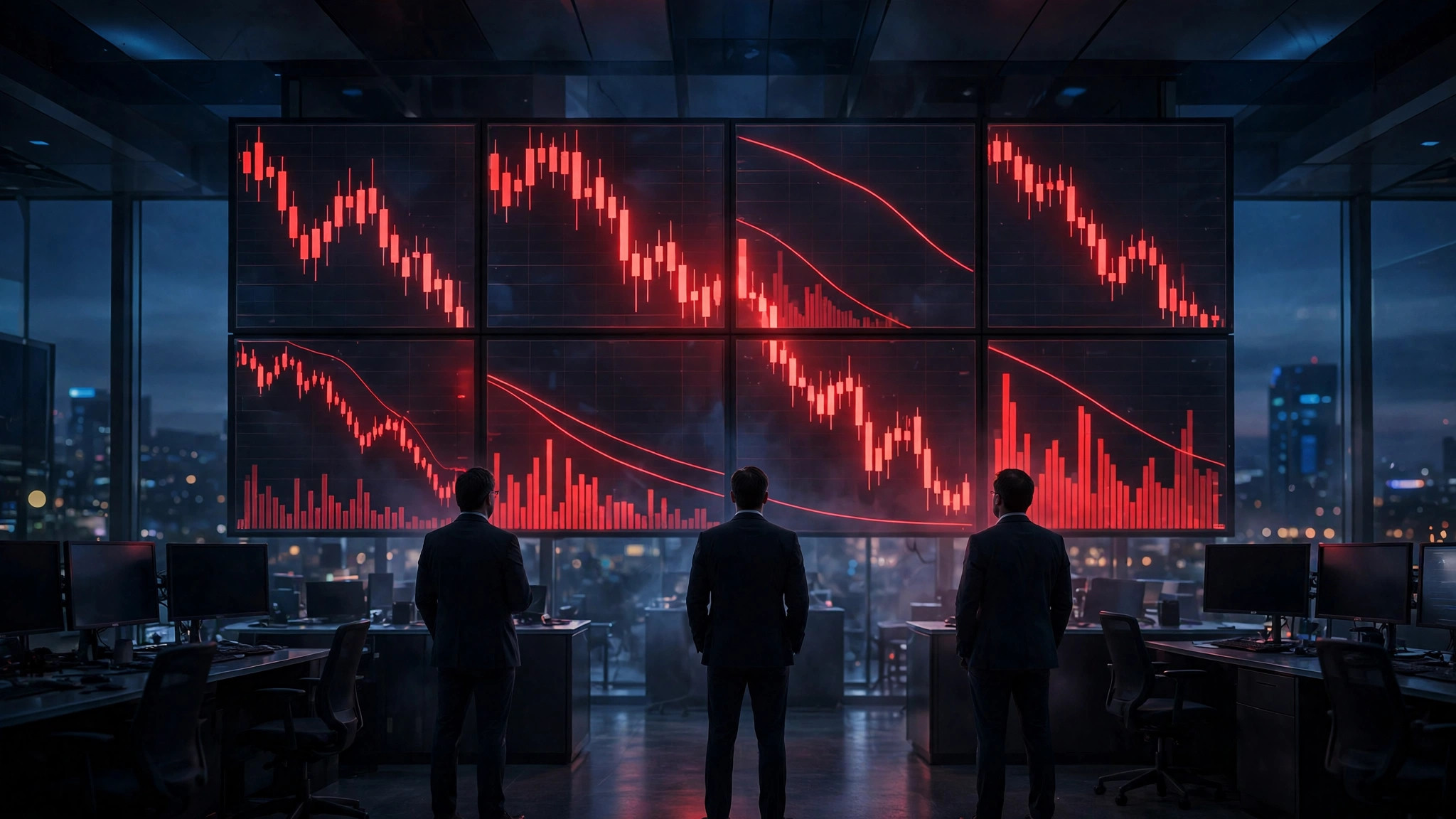
Wall Street suffered its worst day since April 2025 on Thursday, November 5, as a technology-led rout erased the post-midterm rally in a single session. The Nasdaq Composite plunged 5.52% to 24,315.00, a fall of 1,421.52 points that pushed it more than 10% below its October peak and into correction territory. The S&P 500 slid 4.36% to 7,353.73, the Dow Jones Industrial Average dropped 3.44% to 51,523.06, and the Russell 2000 fell 4.45%. Roughly $3 trillion was wiped from S&P 500 companies, and the seven largest technology stocks alone lost more than $1 trillion. All eleven S&P 500 sectors finished lower.
Semiconductors were at the centre of the selling. The Philadelphia Semiconductor Index tumbled more than 12%, with Nvidia down about 9% — enough to turn the chipmaker negative for the year — Broadcom losing more than 10%, and Micron and AMD each falling 17%. CoreWeave dropped 10%, and Qualcomm fell sharply after issuing a weaker-than-expected outlook despite reporting quarterly results that beat estimates. Two worries collided at once. Democratic victories in the US midterm elections raised the prospect of tighter scrutiny of data-centre development, including electricity use, water consumption and local permitting, in states such as Texas. At the same time, investors are questioning how quickly the hundreds of billions of dollars committed to data centres and advanced chips can turn into sustainable profits. The Cboe Volatility Index, Wall Street’s fear gauge, surged about 70% to 28.18.
The rout spread across Asia on Friday. Japan’s Nikkei 225 closed 6.04% lower at 57,389.00, its biggest one-day drop since April 2025, while South Korea’s Kospi tumbled 6.02% to 5,059.69 after a circuit breaker halted trading at the open. Taiwan’s Weighted Index lost 4.47%, Hong Kong’s Hang Seng slipped about 1.1% and Shanghai about 1.2%. Europe had already shown the strain on Thursday: Germany’s DAX and Britain’s FTSE 100 each fell 0.43%, with chip equipment maker ASML down about 6.6% and Infineon about 8.5%. Gulf markets were the exception, with Saudi Arabia’s Tadawul up 0.56% and Abu Dhabi up 0.62%. Brent crude rose 1.59% to $99.85 a barrel on renewed US-Iran tensions, while Bitcoin slid about 6.4% to roughly $75,500 and more than $1 billion in leveraged long positions were liquidated.
Why this matters goes beyond one bad day. The artificial-intelligence trade has been the engine of the 2026 market rally, and Thursday was the first session in which investors repriced two assumptions at once: that data-centre construction would keep expanding without political friction, and that the spending would pay for itself quickly. A correction — defined as a fall of 10% or more from a peak — is not a crash, but the breadth of the selling, from chips to cloud computing to the forex market, where the dollar index steadied near 101.66, suggests a reassessment rather than a one-day panic. Capital is already rotating toward sectors with less exposure to semiconductor valuations.
What to watch next arrives within hours. The US October jobs report is due at 18:30 PKT, with economists expecting roughly 59,000 to 65,000 new jobs and unemployment steady at 4.2%, after just 29,000 jobs were added in September. A strong report would reinforce expectations of another Federal Reserve rate rise in December, which traders now price at about 67%, down from around 82% earlier in the week; a weak one would deepen worries about growth. Until the data lands, position sizing matters more than prediction — our forex tools include calculators for planning risk before trading. (Not financial advice.)