Lesson 5 of 10
Fair Value Gaps (FVG): Trading Market Imbalances
Trading 3-candle imbalances, the 50% CE entry trick, and the inverse-FVG flip signal.
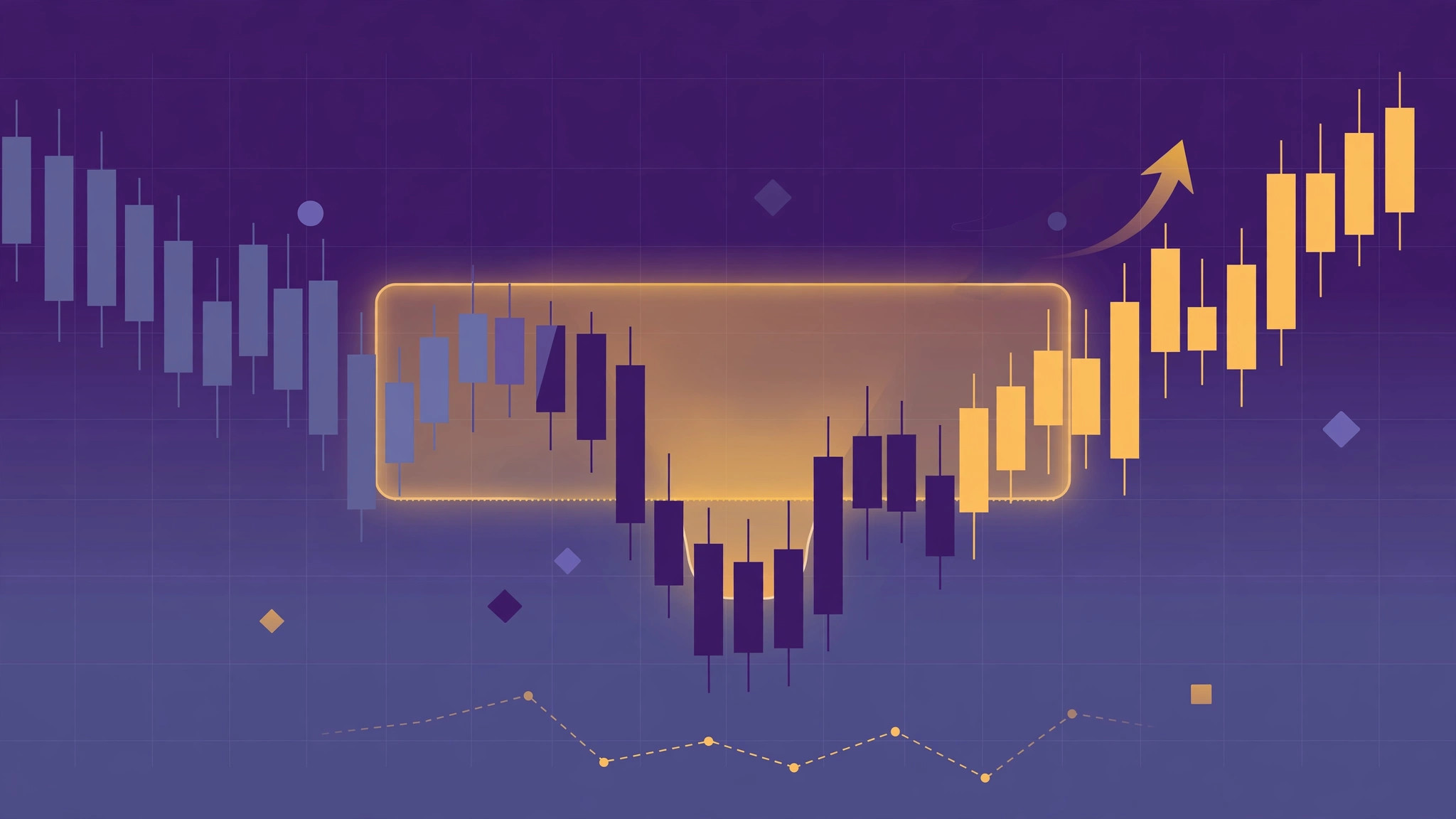
A fair value gap (also called an imbalance) is a 3-candle pattern where price moved so fast that it left an unfilled gap between candle 1's wick and candle 3's wick. The middle candle is a large displacement candle. Markets tend to revisit these gaps to "balance" price before continuing.
(Roman Urdu: Jab price itni tez bhage ke beech mein khaali jagah reh jaye — wohi fair value gap hai. Market aksar wapas aa kar usay fill karti hai.)
Spotting a bullish and bearish FVG
- Bullish FVG: candle 1 high < candle 3 low, with a big green candle in the middle. The gap between them is the imbalance — a potential support zone.
- Bearish FVG: candle 1 low > candle 3 high, with a big red candle in the middle — a potential resistance zone.
The stronger the middle candle (full body, tiny wicks), the more significant the gap.
Consequent encroachment (CE): the 50% trick
Price often retraces to the midpoint (50%) of the gap before reacting — this level is called consequent encroachment. Many traders place limit entries at the CE instead of the gap edge for a tighter stop and better risk-reward.
How to trade FVGs
- 1. Mark fresh gaps created by a genuine impulse (news spikes and displacement legs qualify).
- 2. Wait for price to return into the gap (or its CE).
- 3. Take confirmation: rejection wicks, an engulfing candle, or a lower-timeframe shift.
- 4. Stop loss beyond the gap; target the next opposing liquidity or at least 1:2 reward.
When FVGs fail
- Inverse FVG: if price closes through a bullish gap instead of bouncing, the gap inverts — it often becomes resistance. This flip is itself a tradable signal.
- News: high-impact news (NFP, CPI, rate decisions) can steamroll through gaps.
- Stacked gaps: multiple overlapping gaps usually mean only the freshest, highest-timeframe one matters.
The FVG + order block combination
The highest-quality setups stack concepts. When a fair value gap sits inside an order block, you have two reasons for price to react at the same zone: unfilled institutional orders (the block) plus an unfilled imbalance (the gap).
Practical method: after a bullish BOS, mark the order block. If a bullish FVG overlaps it, refine your entry to the gap's consequent encroachment (50%) — this tightens your stop and often improves reward from 1:2 to 1:3. Enter only with lower-timeframe confirmation; a gap inside a block is still not a guarantee, just better odds. (Roman Urdu: Jab FVG order block ke andar ho — woh zone sab se strong hota hai.)
Track these "stacked" setups separately in your journal. Most traders find their best R-multiples come from confluence zones, not single-concept trades. One caution: after a gap fills completely and price keeps going, the zone is spent — delete it from your chart so stale levels never tempt you into late entries.
Key takeaway: FVGs show where price moved inefficiently. Trade the first revisit with confirmation — and respect the inversion when the gap breaks.
Risk warning: gaps on tiny timeframes fill and fail constantly. Focus on H1+ gaps and never trade them during red-folder news.
Frequently asked questions
Frequently Asked Questions
Is a fair value gap the same as a weekend gap?
No. A weekend gap is a price jump between Friday close and Sunday open. An FVG is an intra-chart 3-candle imbalance formed during continuous trading.
Should I mark every single gap on the chart?
No — charts would become unreadable. Mark only gaps formed by strong displacement, preferably ones that also break structure.
What timeframe is best for FVG trading?
Identify gaps on H1/H4, then drop to M5/M15 for the entry trigger. This top-down approach filters out most low-quality gaps.